A Field Note on returning to Nicholas Ind's Living the Brand twenty-odd years later, and why a brand has to be understood before it can be properly expressed.
Recently, Nicholas Ind reached out after seeing I’d used one of his quotes. A message of thanks, small in practical terms, but one of those moments that quietly opens a door in your brain.
There’s something oddly lovely about being acknowledged by someone whose thinking has been sitting in the background of your own work for years. Not in a dramatic “mentor from afar” way. Nobody needs violins. But in the way, certain thinkers become part of the furniture of your professional mind. You may not quote them every day, but they helped build the room.
That message made me want to pick up his book again.
I first read Living the Brand when it came out — more than twenty years ago. I was still forming my own understanding of what brand actually was, beyond the tidy external things we all learn to point at first. I don’t remember every sentence. Nobody should be held responsible for what their brain retained from a business book two decades ago. But I remember the feeling of the idea landing.
A brand was not only what a business said about itself. It wasn’t only the logo, the campaign, the positioning line, the visual system that made everything look coherent from the outside.
A brand had to be lived.
Not because everything written twenty years ago should be treated as sacred. Brand thinking has changed. Business has changed. Small businesses now operate in public in ways that weren’t invented when Living the Brand was first published. Founders are expected to be visible, coherent, emotionally intelligent, commercially sharp, visually consistent and somehow relaxed about all of it. A calm little ask.
But some ideas become more useful when the conditions around them change. I suspect this is one of them.
The question the book keeps asking feels newly relevant — not just to my own thinking, but also to the stage many small businesses find themselves in right now.
What does it mean for a brand to be lived when the business is small, founder-led and visibly evolving?
For a large organisation, living the brand usually means culture, employee engagement, leadership alignment, and service standards — ensuring that the internal experience supports the external promise. That still matters enormously. A brand that promises warmth while treating people like interruptions is not warm. A brand that claims innovation while punishing curiosity is not innovative. The behaviour tells the truth.
But in a founder-led or small business, the question becomes more intimate.
There may not be hundreds of employees to align. No departments. No internal launch programs or brand champion workshops. Sometimes there’s just the founder, a small team, a handful of collaborators, a website that needs rewriting, and a visual identity that looks like the business it used to be.
In that context, living the brand starts somewhere quieter.
It starts with whether the founder actually understands their brand clearly enough to use it confidently. Not perform it. Not decorate with it. Use it.
Use it to make decisions. Use it to shape offers, messages, visuals, content, proposals, pricing, tone. Use it to decide what belongs and what doesn’t. Use it to make the small everyday choices that slowly, cumulatively, tell people what the business is really about.
This is where Living the Brand feels newly interesting to me.
It’s easy to say a brand is more than a logo. We’ve all heard that line so many times that it’s become almost decorative in itself. True, yes. Useful, only if we keep going.
A brand is more than a logo because it has to guide behaviour. It has to hold meaning. It has to make decisions easier. It has to help the business become recognisable not only by how it looks, but by how it thinks, speaks, chooses, responds and shows up over time.
A brand is not the outfit. It’s the structure underneath the way a business moves. And this is exactly where small businesses often get caught.
They feel the brand wobble first in the visible places. The website feels off. The visuals feel inconsistent. The Instagram grid looks like it’s lived several lives and possibly needs a gentle intervention. The offer language doesn’t quite fit anymore. The proposal deck feels too small for the calibre of the work. The business has shifted, but the brand is still confidently introducing the older version. With slightly outdated shoes.
So the instinct is to fix the surface. And sometimes the surface genuinely needs fixing — I’m not here to pretend that design doesn’t matter. It does. Deeply. People make meaning from what they see, and a poorly expressed brand makes it harder for people to trust.
But if the brand isn’t understood beneath the surface, the surface will keep needing rescue.
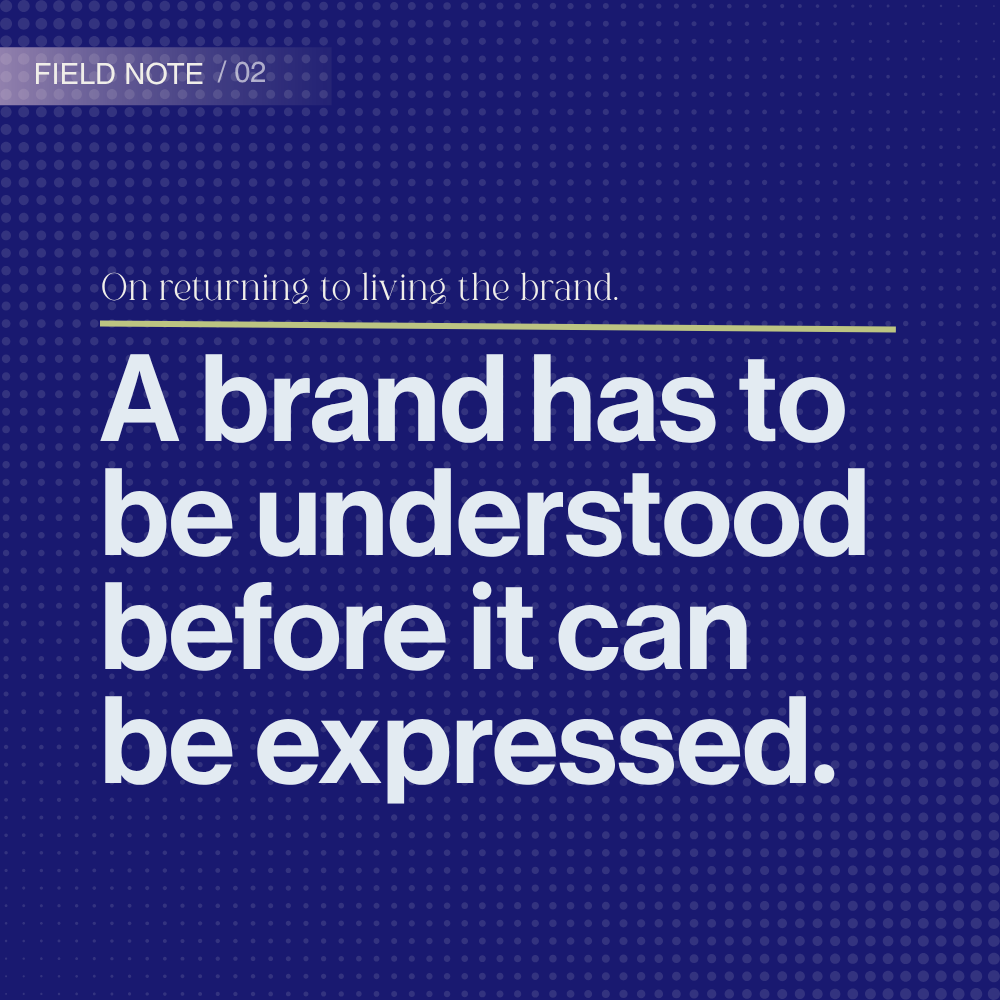
This is the part I keep coming back to: A brand cannot be lived if it isn’t understood.
It can’t be expressed properly if it isn’t understood. It can’t carry more of its own weight if nobody has clarified what it’s being asked to carry.
Ind’s work is often discussed in relation to employees and organisations, but the deeper principle applies at a smaller scale too. People need meaning before they can act coherently. Businesses need meaning before they can express themselves coherently. Founders need meaning before they can stop carrying the whole brand on their shoulders through personal explanation, charm, long emails, and the heroic ability to make things make sense in conversation.
The brand has to become usable. That word feels important. Usable.
Not just beautiful. Not just clever. Not just differentiated. Not just “on brand” — which is a phrase that can mean everything or absolutely nothing, depending on the day and the number of people in the meeting.
A usable brand helps you decide. It helps you write. It helps you brief. It helps you design. It helps you say no. It helps you recognise when an opportunity fits and when it’s just shiny and standing too close. It gives your audience enough signal to place you correctly — before you’ve had to explain yourself again.
For a founder-led business, that can be the difference between momentum and constant reinvention.
The founder often knows more than the brand is showing. That’s one of the patterns I see most consistently. The thinking is there. The care is there. The instincts are there. The work has substance. But the brand hasn’t caught up with the depth of the business, so the founder keeps having to bridge the gap manually.
They explain the nuance in calls.
They clarify the offer in emails.
They reassure people through conversation.
They carry the credibility personally, because the brand expression isn’t doing enough of that work in public yet.
And for a while, that works — especially if the founder is articulate and good at reading people. But it becomes tiring. More importantly, it limits the brand’s ability to build trust before the founder even enters the room.
This is why I keep returning to the belief that sits at the centre of ko&co: Everything works better when you understand your brand.
Not because understanding your brand solves every business problem — it doesn’t. Branding is not magic, and anyone who says otherwise should probably be supervised around moodboards.
But understanding your brand changes the quality of your decisions. It gives design a job to do. It gives language a direction. It gives marketing something more substantial than noise. It gives the founder a structure that isn’t dependent on mood, urgency or the last thing they saw online.
It gives the business a clearer way to behave.
This is also why “living the brand” shouldn’t be reduced to values posters, internal workshops or a neat paragraph in a brand document. A brand is lived in the ordinary choices. The way an offer is framed. The way a client is onboarded. The way a difficult decision is handled. The way a founder writes the homepage after the business has evolved. The way a visual system either supports or quietly undermines the promise. The way a business stops saying yes to work that pulls it sideways — even when the invoice would be convenient and the nervous system would very much like everyone to calm down.
The brand is lived in the pattern.
Which is probably why I’m returning to this book now.
ko&co isn’t trying to invent a new centre. It’s making the real one visible. That process is less like putting on a new outfit and more like recognising the structure that’s been there all along — then giving it enough language, form and discipline to be used.
A brand is not truly alive because it has been designed. It becomes alive when it’s understood deeply enough to be lived, and it is usable.
And that is where the work begins.
Until next time, Kendra x
PS. If your brand looks fine but is hard to explain or grow with, Brand Therapy is a good place to start. We look at what the brand is trying to carry, where the wobble is showing up, and what needs to be clarified before you keep building around it. Brand Therapy: for you and your brand. No couch required.